Composed after a walk in the countryside, Keats’s ode ‘To Autumn’ is regarded as “one of the most nearly perfect poems in English”. How did John Keats reach such a stylistic achievement in writing on a quite banal subject—Nature’s bounties in Autumn?
Autumn has always been my favourite season for its display of Nature’s splendours, especially the rich palette of colours offered by the trees leaves. Though John Keats’s ode ‘To Autumn’ does not refer to this specific feature of the season (too obvious?), it is a real feast of all senses (sight, hearing, smell, taste, and touch) and, speaking of a human experience every one of us may have lived—enjoying the natural beauties offered by the countryside during a warm and sunny autumn’s afternoon—his poem holds an immediate and powerful attractiveness for us. Moreover, the speaker being completely absent from the poem, it potentially raises subtle queries about life and death in the reader’s mind.
The subject—Autumn and its abundant, natural bounties—had already been treated by poets for centuries, from Homer to the preceding Augustan poets. In the first part of this essay, I will show that, if Keats may have been influenced by some of the classical artists in his poetical language, his approach to the subject is quite original. In the second part, I will examine, through a close reading of his poem, how Keats used the liberty provided by the irregular ode for expressing his thoughts in a subtle and distinctive style, which may be regarded as the antipode of Shelley’s personal style in ‘Ode to the West Wind’, though the two poems deal with Autumn and were written at the same time (1819). I thus found interesting, in a third part, to briefly compare some stylistic features of the two poems. To conclude, I will give my personal response to Keats’s last ode.
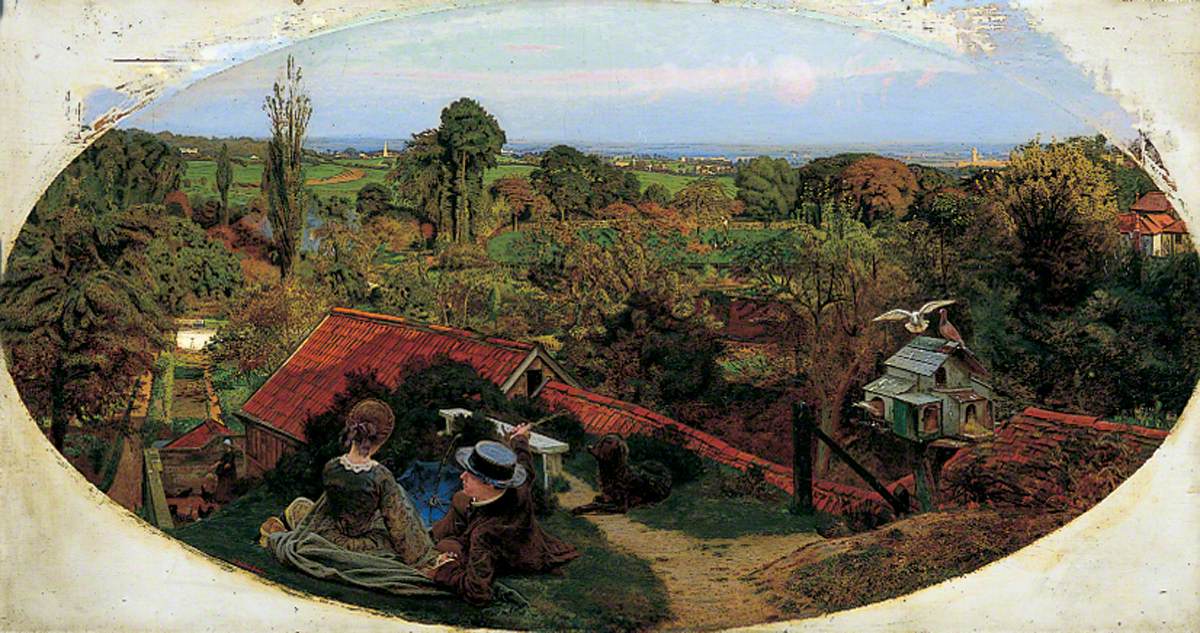
Illustration on top of this page: Ford Madox Brown, An English Autumn Afternoon (Hampstead, 1854), https://artuk.org/discover/artworks/an-english-autumn-afternoon-33599
“While barred clouds bloom the soft-dying day / And touch the stubble-plains with rosy hue…”
John Keats, ‘To Autumn’ (lines 25-26), September 1819
 The eternal student - anglophile version