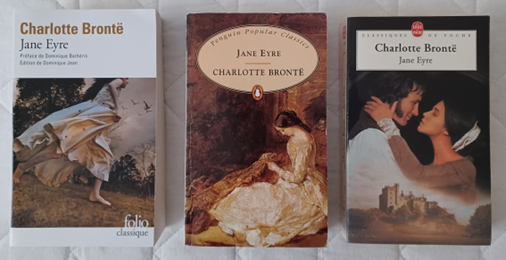
I read this great classic of British literature, which belongs to the World Literature canon, from a feminist perspective. Interestingly, three of its translations in French, published at various periods, not only reveal the evolution of the society and culture contemporary of each translator, but also of the evolution of translation techniques.
For almost two centuries, Charlotte Brontë’s novel Jane Eyre has never ceased to be enjoyed by successive generations of readers, studied by scholars, published, and translated to many languages. The modernity and universality of the social issues it deals with make this work a cornerstone of the World Literature canon. Beyond the romantic and gothic appeals of its plot, the powerful grip of Brontë’s novel on its readers can be explained by the intimacy and the easy identification with the heroine. Millions of people, who struggle in their own lives, feel close to Jane Eyre when they read her story. I chose to study this novel through the lens of feminism, thus focusing on gender and class issues. To illustrate my arguments, I selected a short extract from chapter 12, which—after Mary Wollstonecraft’s work A Vindication for the Rights of Woman (1792)—has also been regarded as a feminist manifesto. Then I compared three different translations of this passage in French, all representative of various periods, cultures, and translation techniques.
 The eternal student - anglophile version