When one thinks about Regency England, a writer comes immediately to one’s mind: Jane Austen, whose novels describe the life of country gentlefolk during that period. And yet, the growing, educated, middle-classes started to dwell in London suburbs and develop a new way of life. Among them, John Keats and his circle of friends wrote breakthrough poetry, which disturbed Britain’s establishment. Considering Keats’s aesthetic of nature in his poetry, as well as his influence as a “poet-painter” on the following generations of artists, can we still regard him as a Romantic poet or should we rather regard him as a Regency, even as a pre-Victorian, poet?
Since John Keats’s death two centuries ago, it seemed that everything had been written on his poetry, on his short life, on his artistic legacy… until eco-criticism brought about some new perspectives on his work. Supported by recent essays (written from the early 1990s to 2021), this research paper explores the representation of Nature in Keats’s poetic universe and studies its evolution throughout his career. To do so, it was necessary to examine first the aesthetic of nature in 18th– and 19th– century England, identify the Regency Era as a pivotal period in the evolution of “domesticated nature” and locate Keats’s aesthetic of nature in one of the first elegant Regency suburbs developed near London, Hampstead more precisely—far from the Romantic Sublime, still praised by his contemporaries. Like Repton’s Regency gardens, Keats’s nature displays natural and artificial elements—his flower imagery and landscapes reflecting his thorough knowledge of botany, the places he visited, classical paintings and stories, British poetry, etc.—and this mixture was representative of the culture of his social circle. Ruthlessly criticized by some contemporary reviewers, his composite representation of nature anticipated Loudon’s aesthetics for Victorian suburban garden, and the relationship Victorians would develop with Nature…
I invite you to read the complete essay, available in the pdf document here above, and I hope you’ll enjoy reading it. You may download it and use parts of it for your own research work but beware of plagiarism: do not forget to indicate your references as soon as you quote, reformulate, or cite any part or idea written in this essay.
In this study, I often refer to another research paper I wrote for my exam in Corpus Linguistics, in January 2024. Here it is:

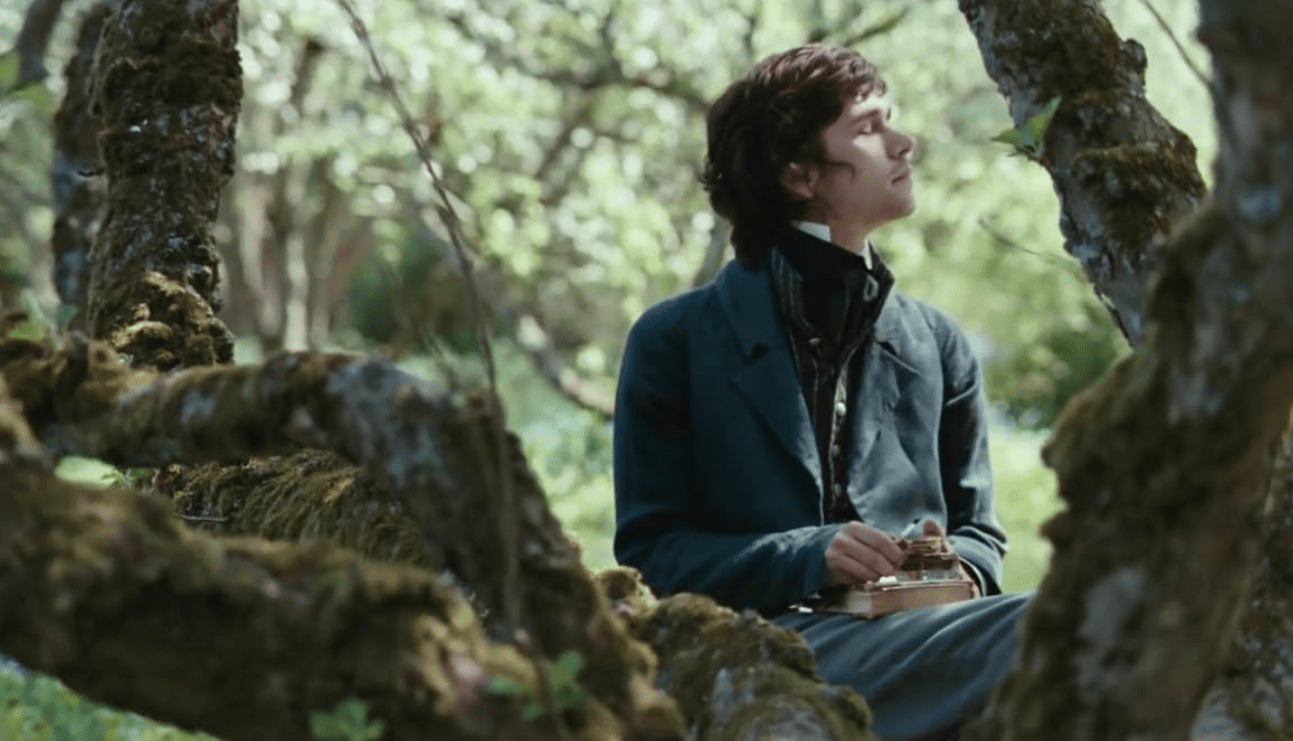
Important note: The photos of Bew Wishaw, playing John Keats in Bright Star, 2009, by Jane Campion, come from this website: Bright Star (2009) (imdb.com)
My story with John Keats
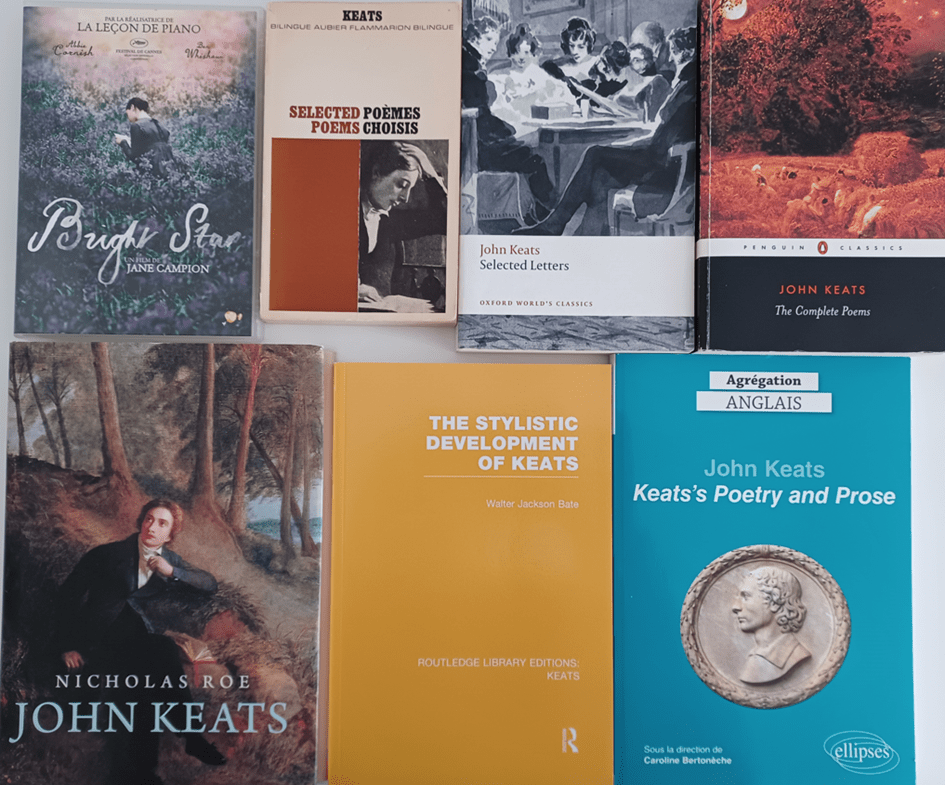
My first “encounter” with John Keats dates to 2018, when I enrolled in a summer programme at Cambridge University. After my first year at the University of Lorraine, I had taken a gap year for personal reasons, and the following summer, I treated me with a two-week literature course at Cambridge. One of the four courses I enrolled in was about Wordsworth’s Lyrical Ballads and Keats’s letters and poems published in 1820. The reason why I chose it was that the study of British Romantic poets was not part of our undergraduate curriculum at university, and I longed to discover why they had impressed so much on the collective imagination of British people. During the Spring preceding the programme, I bought all the recommended books and read the novels for the three other courses. Meanwhile, I started studying poems from Lyrical Ballads, 1802 on the one hand, and Keats’s works on the other hand. Entering Keats’s personal life through reading his letters moved me and encouraged me to study first his narrative poems, from The Eve of St Agnes to Lamia. When I did some research on the internet, I found several Pre-Raphaelite paintings which were inspired by these poems and brought about interesting perspectives on them. For someone with a scientific background like me, studying poetry was already a challenge, and I soon realized that deciphering some of Keats’s verse, with their density and many references to mythology, demanded a lot of work! But it was worth it: not only did I greatly enjoy my literary journey in Romantic poetry, but at the end of that summer course, guided by a learned teacher, I even wrote my first academic essay, discussing this opinion about Keats: “When one speaks of Keats’s greatness, one means his potential, rather than actual achievement.”
The more I explored Keats’s universe, the more I felt touched and at one with it. The seed was then planted and developed quietly until October 2020, when I started to study for a master’s degree. As I knew that I wanted my thesis to revolve around Keats’s poetry and the Pre-Raphaelite paintings, as soon as I could choose my topic for a research assignment, I dug into one of these areas… I thus listened to and watched many lectures (https://eternal-student.com/2024/03/24/a-wealth-of-lectures/), wrote an essay on Keats’s last ode, ‘To Autumn’ (https://eternal-student.com/2024/03/24/essay-on-to-autumn/) and discussed ‘La Belle Dame Sans Merci, A Ballad’ in another essay (https://eternal-student.com/2024/03/24/mediaeval-literature-in-todays-world/).
Finally, in summer 2021, a short lecture by Caroline Holmes, intitled “Keats and Regency Domestic Gardens,” opened a new door to my imagination, while I had to close a few others, because some areas of research about Keats that I had previously envisaged seemed to be–unfortunately–worn-out academic subjects… To me, nature in Keats’s poems was more reflecting English cottage gardens than the scenic sublime of Wordsworth’s Lake District, and as I could only find very few academic articles about this theme, I got a “green light” from my director to work in that direction for my thesis subject. When he suggested that I could introduce a paragraph about 18th-century garden poetry, I started digging into this area as well…
When I started writing the very first draft of my master’s thesis in July 2022, the paragraph about “the evolution of garden poetry in British literature” had developed into a whole study of English gardens and landscapes, and their representation in arts, of more than 50 pages. I had so much enjoyed writing this part that I kept it, thinking then that I would just pick and choose what would be relevant for the final draft of my thesis once its subject would be definitively defined. After I wrote the draft of the second part, dealing with the representation of Nature in Keats’s poems, and counting more than 50 pages too, I realized that my thesis project was growing out of control, and that a serious talk was needed with my director!
To cut a long story short, when I presented my final 110-page thesis to the exam jury in April 2023, I had finally managed to put in my thesis the three topics I had so much enjoyed studying for the five previous years—Keats’s poetry, English gardens and landscapes, and Pre-Raphaelite paintings—articulated around this theme: “Considering Keats’s aesthetic of nature in his poetry, as well as his lasting influence as a “poet-painter” on the following generations of artists, can we still regard him as a Romantic poet or should we rather regard him as a Regency, even as a pre-Victorian, poet?” Despite the enthusiasm of my director for it, and the fact that the jury found it well documented and “a pleasant reading,” they pointed out that the structure should be reviewed and that “my voice” was not heard enough in the text. Thus, I only got a 14/20. Though I was disappointed, I could not disagree with them: If I had indulged me in writing what I liked, I had forgotten in the process that it was first and foremost an academic exercise with specific rules to follow…
One year later, I thought that it was a good time to rework that material into three different documents, to give them a better chance independently. The original draft of the first part has thus been reviewed and enriched in a new article entitled “The distinctive personalities of England’s gardens and landscapes and their representations in arts in “modern” history”, available here on my blog: Three Sisters: Poetry, Painting and Gardening – The eternal student – anglophile version (eternal-student.com)
I have refocused the text of my original thesis on Keats, restructuring the document and enriching it with the concrete results of a later research in corpus linguistics, into what has become my “Magnum Opus” ! I do hope that you’ll enjoy reading it as much as I did writing it!
Finally, a paragraph in the third part of my master’s thesis, dealing with the influence of Keats’s poetry in Pre-Raphaelite paintings, will soon become a new, independent post on my blog… Watch out!
 The eternal student - anglophile version