
“We are now on the point of leaving [Livorno] for Florence, where we have taken pleasant apartments for six months, which brings us to the first of April, the season at which new flowers and new thoughts spring forth upon the earth and in the mind. What is then our destination is yet undecided. I have not yet seen Florence, except as one sees the outside of the streets; but its physiognomy indicates it to be a city, which, though the ghost of a republic, yet possesses most amiable qualities.” This is the beginning of a letter the poet Percy Bysshe Shelley wrote to his friend Leigh Hunt on 27 September 1819. Though he actually stayed four months in Florence, there he found inspiration and energy to write his most famous poem, ‘Ode to West Wind’, complete Prometheus Unbound, which is classed by many as his major work, and begin his major political essay ‘A Philosophical View of Reform’.
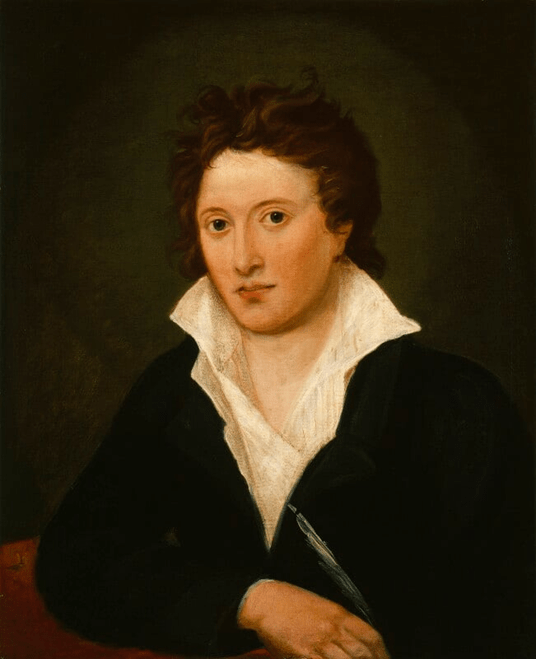
Contemporary portrait of Shelley by Amelia Curran (1819), courtesy of the National Portrait Gallery (NPG 1234)
Percy Bysshe Shelley (1792 – 1822), together with Lord Byron (1788 – 1824) and John Keats (1795 – 1821) were later known as the second generation of the British Romantics poets. All three died young. Shelley’s short, prolific life produced some of the most memorable and well-known lyrics of the Romantic period. Though a member of the British elite himself, he was the most radical writer in the English literary tradition of his day, a fiery political visionary committed to social change and progress. Self-exiled in Italy with his wife Mary—the author of the Gothic novel Frankenstein; or, The Modern Prometheus (1818)—and Claire Clairmont since March 1818, they had been constantly on the move: Milan, Bagni di Luca, Venice, Naples, Rome, Livorno, and now Florence. Meanwhile, Shelley deepened his understanding of art and literature. Unable to reshape the world to conform to his vision, his passionate search for personal love and social justice was gradually channelled from overt actions into poems that rank with the greatest in the English language: the American literary critic Harold Bloom described him as “a superb craftsman, a lyric poet without rival, and surely one of the most advanced sceptical intellects ever to write a poem.” Contrary to his friend Lord Byron, Shelley did not achieve fame during his lifetime, but his poetical achievements have been recognized after his death and have influenced subsequent generations of poets.
Like a literary echo of my recent winter trip to Florence (see: https://eternal-student.com/2025/02/06/a-long-weekend-in-florence/), this article will focus only on the poet’s life and work when the Shelleys lived in Florence, i.e., from October 1819 to January 1820. You will find at the bottom of this page a handout including some of Shelley’s poems as well as some illustrations, useful information and references.
In September 1819, when Shelley heard of the massacre which had happened on 16 August on St Peter’s Fields, outside Manchester, he poured down his anger in The Mask of Anarchy, his most forceful poem, in which he called on the people of England to “Rise like lions after slumber / In unvanquishable number; / Shake your chains to earth like dew / Which in sleep had fallen on you. / Ye are many, they are few.”
At the end of that month, he moved to Florence with his family circle: “We expect Mary to be confined towards the end of October. The birth of a child will probably retrieve her from some part of her present melancholy depression” (Letter to Leigh Hunt, 27 September 1819). Indeed, when Mary gave birth to their fourth (and only surviving) child on 12 November 1819—a son named after his father and his birthplace, Percy Florence Shelley—she began “slowly to return to something like her old self” and “the positive presence of Mary was felt again, as if she had now returned to his life… The connection between Mary’s baby and his own sources of creativity and hope, runs deeply through all the poetry of this autumn, gradually emerging in the imagery, and finally becoming explicit in [his] letters of November” (Richard Holmes, Shelley: the Pursuit, pp. 560 and 556).
Indeed, Shelley drew inspiration from his daily life in Florence. In a letter to the Gisbornes on 6 November 1819, he wrote: “we have had lightning and rain here in plenty. I like the Cascini very much, where I often walk alone, watching the leaves, and the rising and falling of the Arno. I am full of all kinds of literary plans.” One of them became his ‘Ode to the West Wind’, that the poet composed around the 25 October and introduced with a note: “This poem was conceived and chiefly written in a wood that skirts the Arno, near Florence, and on a day when that tempestuous wind, whose temperature is at once mild and animating, was collecting the vapours which pour down the autumnal rains. They begun, as I foresaw, at sunset with a violent tempest of hail and rain, attended by that magnificent thunder and lightning peculiar to the Cisalpine regions…” (The Selected Poems and Prose of Shelley, p. 401). However, his poem should not be read simply as a ‘nature’ poem. Contrary to the fatalism of Keats’s ‘To Autumn’, Shelley’s ode sees the decay and corruption of autumn as a necessary part of the process leading to renewal: “O Wind, / If Winter comes, can Spring be far behind?” His west wind is the embodiment of transformation, connecting natural and social change (The Selected Poems and Prose of Shelley, introduction p. xxxiv). Shelley’s aim becomes to make his words “Ashes and sparks” as from “an unextinguished hearth,” thereby transforming subsequent generations and, through them, the world. The whole poem is available in the handout below, and a comparative study of this poem with Keats’s ode ‘To Autumn’ is available on my blog: Essay on ‘To Autumn’ – The eternal student – anglophile version.
The week after, Shelley composed the 152 stanzas of his satirical attack on Wordsworth, entitled Peter Bell the Third. In his introduction to The Selected Poetry and Prose of Shelley (p. XLI) Bruce Woodcock finds that, though hardly Shelley’s best verse writing, this poem has “a madcap wit that offsets the virulent satire of social hypocrisy and political corruption… in the satirical manner of his friend Byron, whose own incendiary The Vision of Judgement (1821) [would] attack Southey and the Lake Poets with a comic brilliance Shelley hardly matches.” You will find the link to read Peter Bell the Third in the handout below, and an introduction to The Vision of Judgement in one of my previous posts: Lord Byron, the first European superstar… – The eternal student – anglophile version.
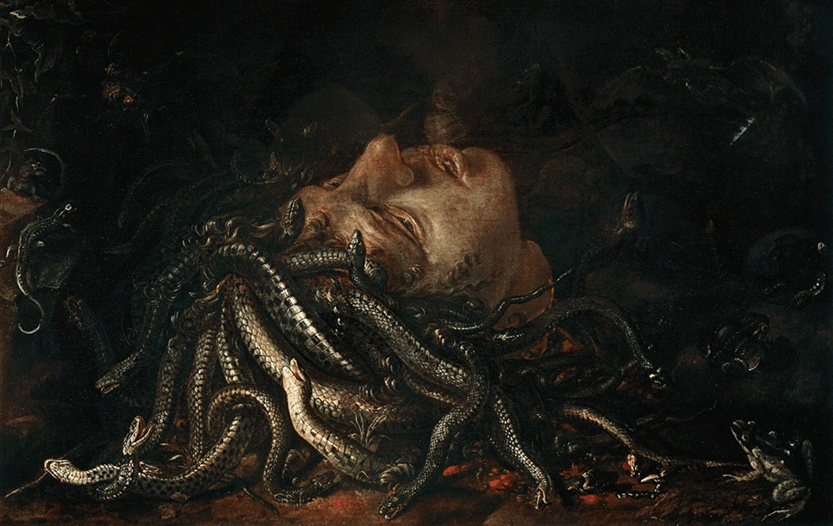
While in Florence, Shelley had “a design of studying piece-meal [the Uffizi Gallery]; one of [his] chief objects in Italy being the observing in statuary and painting, the degree in which, and the rules according to which, that ideal beauty, of which we have so intense yet so obscure an apprehension, is realised in external forms” (Letter to Mrs Gisborne, 13 or 14 October, 1819). He did visit the galleries very often during his stay, writing his observations in his notebooks, later published in his prose work as ‘Notes on Sculptures in Florence’. For Richard Holmes, “Shelley’s descriptions… tend to concentrate on two aspects of the sculpture. One is the technical details of drapery, limb-joint, and posed gesture by which a voluptuous or explicitly sexual effect is achieved by the sculptor. The other is emotional, or more especially, the moral characterization expressed by a figure or group… his remarks tell far more about his own feelings than about the way the piece of stone was carved” (p. 566). “Further study of the artistic effect of combining beauty with great pain or revulsion produced the unfinished poem ‘On the Medusa’, which meditates on the qualities of a repulsive picture then attributed to Leonardo” (p. 567) but now believed to be a work of an anonymous Flemish painter, active around 1600 (Public Domain: Medusa uffizi – Medusa (Leonardo) – Wikipedia):
In December, Shelley included a powerful sonnet, ‘England in 1819’ at the end of a letter to Leigh Hunt, but he had lost his illusions about the publication of his political poems in England:

He also wrote several short love-lyrics intended to be sung to music, including ‘Song Written for an Indian Air’ also entitled ‘The Indian Girl’s Song’, and ‘Love’s Philosophy,’ the latter being the only piece of poetry which was published in the last issue of the year of The Indicator, Hunt’s literary paper.

The texts of these poems are available in the handout below.
During his stay in Florence, Shelley completed the fourth and last act of Prometheus Unbound, introduced by Bruce Woodcock as “a visionary work”, which “functions simultaneously on psychological, social, historical and cosmic levels, achieving through poetic drama a complexity similar to that of Blake’s mythology in his prophetic books” (p. xxxviii). He also embarked on his greatest political essay, A Philosophical View of Reform, which would only be published a century later, in 1920: “the most impressive piece of political prose by any of the Romantic poets” (Introduction, p. LI). Some sections of this essay, dealing with the relationships between literature and politics, were later adapted and developed into A Defence of Poetry (1821), in which the sentence “Poets and philosophers are the unacknowledged legislators of the world” from A Philosophical View of Reform was shortened into “Poets are the unacknowledged legislators of the world”, thus becoming the most famous phrase of Shelley’s prose.
Shelley’s impressive productivity during his four-month stay in Florence only gives a glimpse of his intellectual powers as a poet and philosopher. Except some of his political poems, written as clarion calls for the people of England, or his love lyrics, Shelley’s poetry may be rather difficult to approach and often demands a lot of work from his readers. But Richard Holmes’s epic biography of Shelley, entitled Shelley: The Pursuit, not only offers a captivating portrait of Shelley as a man and a writer, but also a portal to access his poetry and prose.

Photo on top of this post: View on the Ponte Vecchio and the Arno from the Uffizi Galleries.
 The eternal student - anglophile version
#/media/File:Medusa_uffizi.jpg)
Beautiful ♥️
LikeLike