In May 2013, the NI government established a 10-year programme to reduce and eventually remove all interface barriers. What are these “interface barriers” and why were they erected? As we met the 2023 deadline, to what extent has this programme been implemented?
When I watched a documentary about Belfast peace walls a few years ago, I was shocked to learn that such barriers still existed after more than 20 years of a relative peace in Northern Ireland (NI). Our literature class dealing with “the echoes of the Troubles”, I seized this opportunity to do some thorough research on NI’s specific history and culture for another assignment, this one required by our civilisation class teacher. As the centenary of the creation of Northern Ireland was celebrated in 2021, I decided to explore in the first part of this essay the historical and political contexts explaining Northern Ireland’s unique situation in today’s Europe, and why, after almost 25 years of a relative peace, this area is still so volatile.
The more I dug into this fascinating subject, the more complex did the situation in NI appear to me. For example, beyond the Catholic-nationalist-republican and Protestant-unionist-loyalist dichotomy, other divisions in Northern Ireland rest upon social classes. NI is still the poorest part of the UK, and the unemployment rate—especially within young people—is the highest in the kingdom. Why are sectarian issues so deeply rooted in NI’s society despite many government policies and huge international funds allocated to peace building?
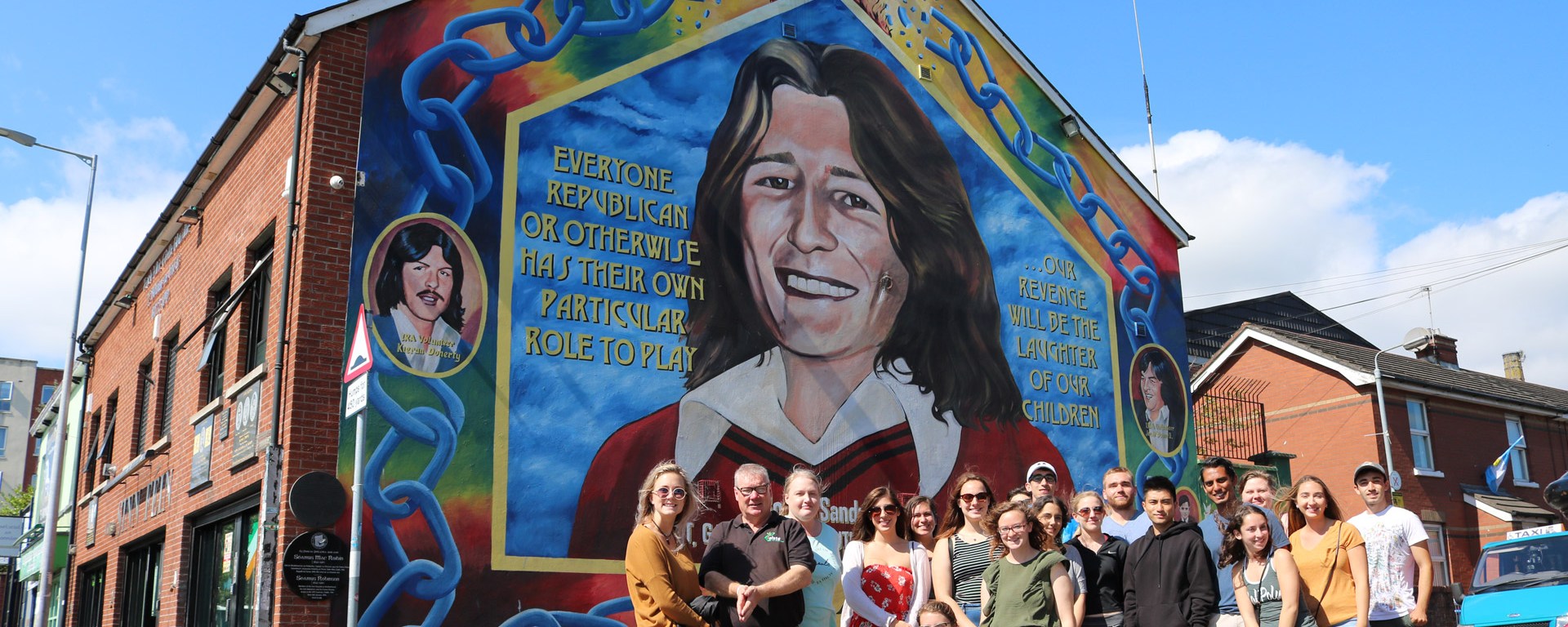
With the decline of industry, Northern Ireland has developed tourism as an economic activity for the last decade, with a museum celebrating the Titanic and the glorious past of Belfast shipyards, and with “dark tourism” flourishing on the legacy of the Troubles, such as the murals on peace walls and memorials in cities like Belfast and Derry/Londonderry.
Drawing from this paradox—how peace walls, conspicuous symbols of sectarianism and conflict, have become works of art visited by international tourists—I analysed academic papers and newspaper articles about Belfast’s peace walls in the second part of this essay, with the aim to answer the following questions: why, when and where were these interface barriers erected, and why did the NI government decide in 2013 to remove them within ten years? As the deadline will be reached in a few weeks, why so few walls have been knocked down? Do other barriers than these obvious ones exist in NI urban landscapes, and what are their impact on NI society?
I invite you to read the complete essay, available in the pdf document here below, and I hope you’ll enjoy reading it. You may download it and use parts of it for your own research work but beware of plagiarism: do not forget to indicate your references as soon as you quote, reformulate, or cite any part or idea written in this essay.

