Wales is a land of legends—including King Arthur’s, music, and wonderful landscapes. Every day, this tour provided me with new enjoyments and pleasures, from the breathtaking mountains of Snowdonia to the delightful coastal towns and fishing villages. Every corner of this beautiful country is packed with history: from the many medieval castles to St Fagans National Museum of History, this trip also allowed me to travel back in time. And the warm welcome from the locals was the icing on the cake!
If you have never been to Wales, I invite you to open my photo album below and follow in my footsteps. And if you are lucky enough to have already visited Wales, I think that my photos could remind you some happy memories. If you are interested in a few facts about this colourful nation, you will find some useful information below my photo album.
Wales: a few facts
Covering an area of 20,735 km² and with a population of 3,132,000 in 2022, the small nation of Wales forms a westward extension of the island of Great Britain. The capital and main commercial and financial centre is Cardiff. Famed for its strikingly rugged landscape, Wales—Cymru in the Celtic language—was one of Celtic Europe’s most prominent political and cultural centres, and it retains aspects of culture that are markedly different from those of its English neighbours and justify a contemporary nationalism. During ceremonies, the national flag—a red dragon on a green and white background—proclaims the determination of some not to align themselves with the other banner, the English royal standard, which, since 1953, has been enhanced with a coat of arms surmounted by the imperial crown.
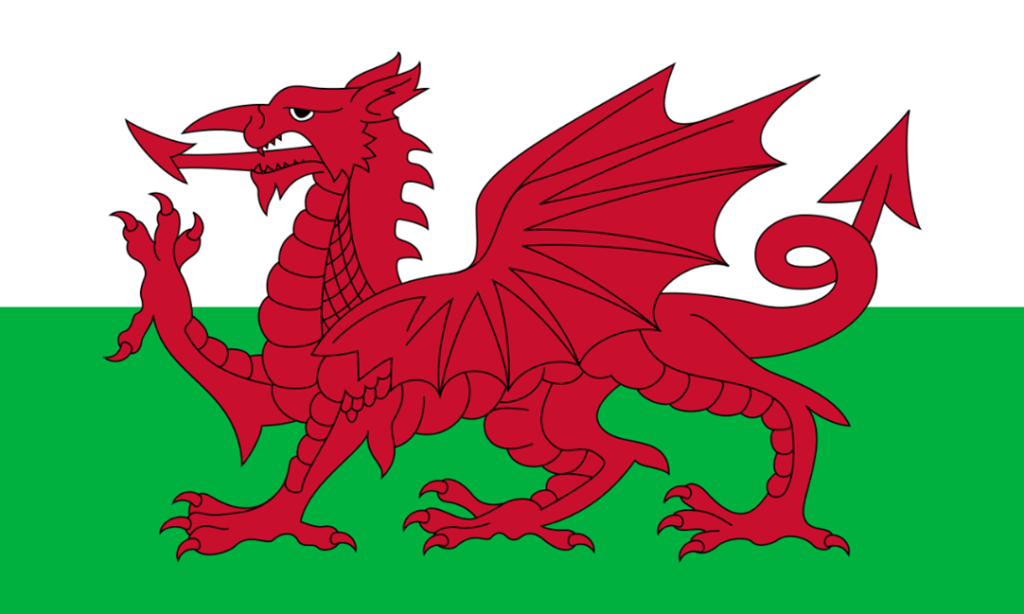
Flag of Wales, Public Domain
If Wales has kept a deep-routed Celtic soul, fed by its own legends and music, it also has a very rich and complex history. In the 11th century, the Norman Conquest of England saw the establishment upon the Welsh border of the three earldoms of Chester, Shrewsbury, and Hereford, and from each of these strongpoints, advances were made into Wales.
Today, one of the most prominent features that travellers cannot fail to notice are the ruins of many fortified castles all over the country. Indeed, Edward I (1239-1307) provided for the security of his conquests by means of a program of castle building, initiated after the war of 1277 and subsequently extended to include the great structures of Conwy, Caernarfon, Harlech, and, later, Beaumaris. Each castle sheltered a borough where English colonists were settled.
From the 14th century, Wales became more closely integrated into the English political system than Scotland or Ireland ever were, especially under the reign of Henry VIII: with the Act of Union in 1536, Wales was formally joined to the kingdom of England. The union legislation, stressing the need for uniformity with the realm, required for those who participated in administration under the Crown to use the English language.
The need to secure Protestant faith, however, led to an acknowledgement that the Welsh language had to be used in public worship. Indeed, making the Word of God understandable to the people was a very important part of the Protestant Reformation. The translating of the Bible into Welsh during Elizabeth I’s reign facilitated the transformation of Wales into a Protestant country. Translations of the New Testament and the Book of Common Prayer were published in 1567, and William Morgan’s translation of the entire Bible in Welsh appeared in 1588. Alone among the Celtic nations in securing the Scriptures in the vernacular within half a century of the Reformation, the Welsh people had scored a success of profound significance for the future of the language and the sense of nationhood.
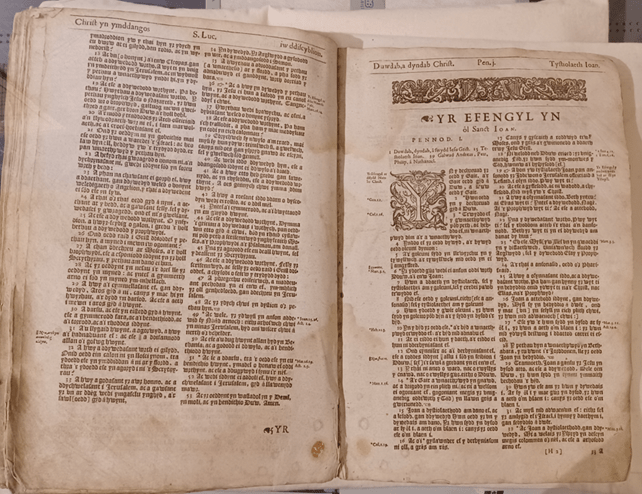
1620 edition of a Bible in Welsh, St Davids Cathedral Library (own photo)
Wales has retained deep traces of a distinct population, specific customs and culture, and a history of independence. While Welsh engineers, linguists, musicians, writers, and soldiers went on to make significant contributions to the development of the larger British Empire, as many of their compatriots laboured at home to preserve cultural traditions and even the Welsh language itself, which enjoyed a revival in the late 20th century.
Although Wales was shaken by the decline of its industrial mainstay, coal mining, by the end of the 20th century the country had developed a diversified economy, particularly in the cities of Cardiff and Swansea, while the countryside, once reliant on small farming, drew many retirees from England. Tourism became an economic staple, with visitors—including many descendants of Welsh expatriates—drawn to Wales’s stately parks and castles as well as to cultural events highlighting the country’s celebrated musical and literary traditions.
In 1997 the British government, with the support of the Welsh electorate, provided Wales with a measure of autonomy through the creation of the Welsh Assembly, which assumed decision-making authority for most local matters. The evolution of the political situation has allowed Welsh distinctiveness to assert itself, though the intensity of local nationalism cannot be compared to Scottish nationalism, let alone Irish nationalism.
However, beginning of May 2026, the nationalist party Plaid Cymru won Welsh Senedd elections, ending 100 years of Labour control. According to The Guardian, the Plaid win makes a Welsh independence referendum a future possibility and means all three of the UK’s Celtic nations will now be controlled by separatist parties.
A few personalities in literature, music and cinema can boast their Welsh origins: the actors Richard Burton (1925-1984), Anthony Hopkins (b. 1937), Timothy Dalton (b. 1946) and Catherine Zeta-Jones (b. 1969), the singers or musicians Shiley Bassey (b. 1937), Tom Jones (b. 1940) and Bonnie Tyler (b. 1951), the writer Roald Dahl (1916-1990) and the poet Dylan Thomas (1914-1953).
(Sources: Articles about Wales in the Encyclopaedia Universalis and Encyclopaedia Britannica).
Poem: “And death shall have no dominion” by Welsh poet Dylan Thomas (1914–1953).
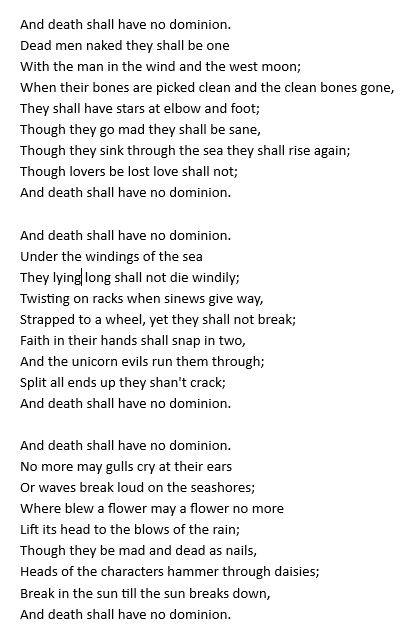
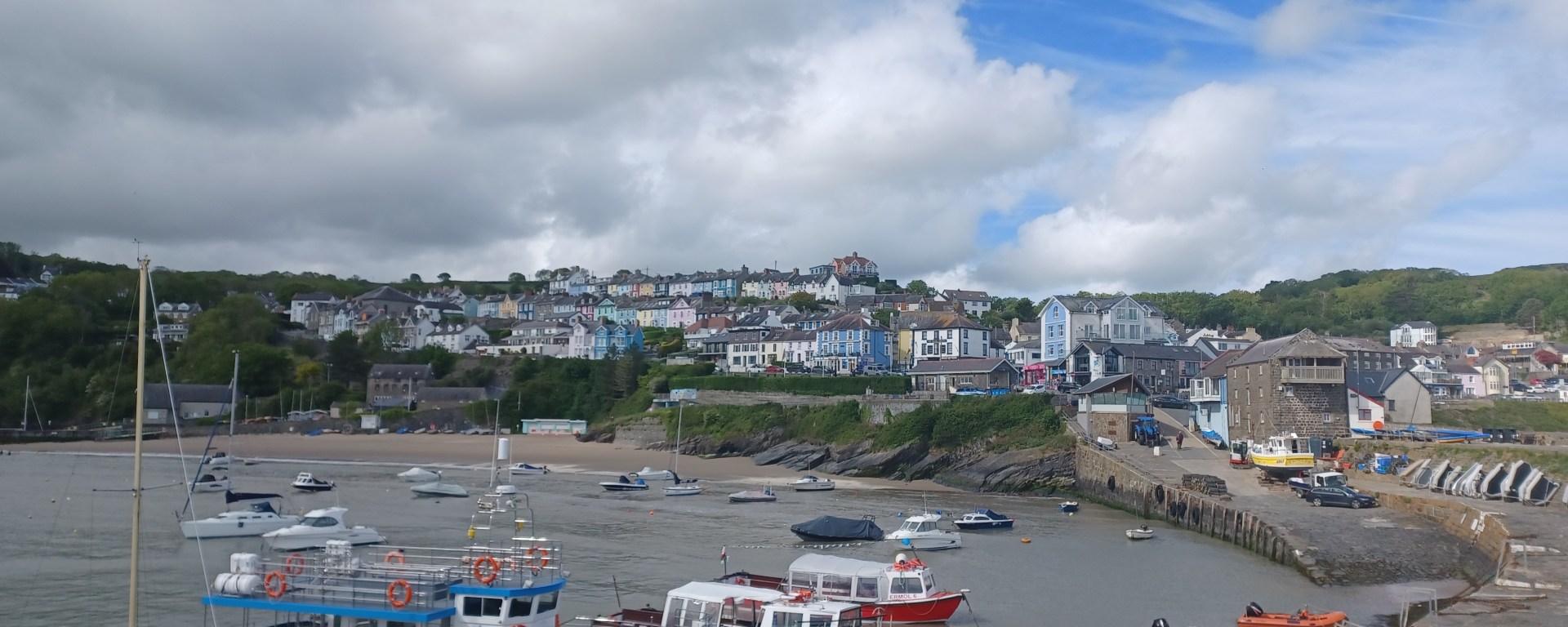
Illustration on top of this post: New Quay, Cardigan Bay, Wales (own photo)


Super, Eva!
Tes voyages par le UK sont magnifiques. Tu devrais rassembler tout dans un livre avec des belles photos. 👍👏
Mon fils a fait ses études à l’Université de Swansea (Abertawe, en gaélique). Et lui et sa compagne ont fait un tour par Wales aussi en mai. Peut-être que vous vous avez croisé sans le savoir.😄
Je suis à Maiorca avec mes filles et petite-fille. Je suis très agréablement surprise. Je pourrais y vivre 😊
Grosses bises Filo
LikeLiked by 1 person